Knowledge
Why Channel Focused Digital Marketing Never Moves the Needle

Knowledge
Human Shaped Thinking
28 July 2026

Gav StevensHead of Performance Marketing
That instinctive sense that no matter how good they appear to be - sharper SEO, more effective paid ad targeting and better social media management - they will not manage to deliver the results you want.
Your scepticism is well placed. Channel focused digital marketing simply can not deliver the kind of transformative revenue growth that maximises a business’s potential.
In this article, I’m going to explain why this is the case, identify what the real problem is and talk through what you can do about it.
It’s easy to think that you just need to find a digital unicorn: a one-off, super rare, exceptional agency, one who can execute SEO, PPC, and social better than anyone you’ve ever come across before.
After all, this is the only solution you’re seeing on the market: agencies selling high-quality, demonstrable channel competencies.
Most of these agencies are probably very capable and typically illustrate how good they are with data-backed case studies, charts and rankings. So ‘better execution’ becomes the logical and sensible conclusion.
The issue is that better execution can't fix a marketing problem that has nothing to do with your digital channels.
To understand why, we need to take a closer look at buyer behaviour ‘in the wild’.
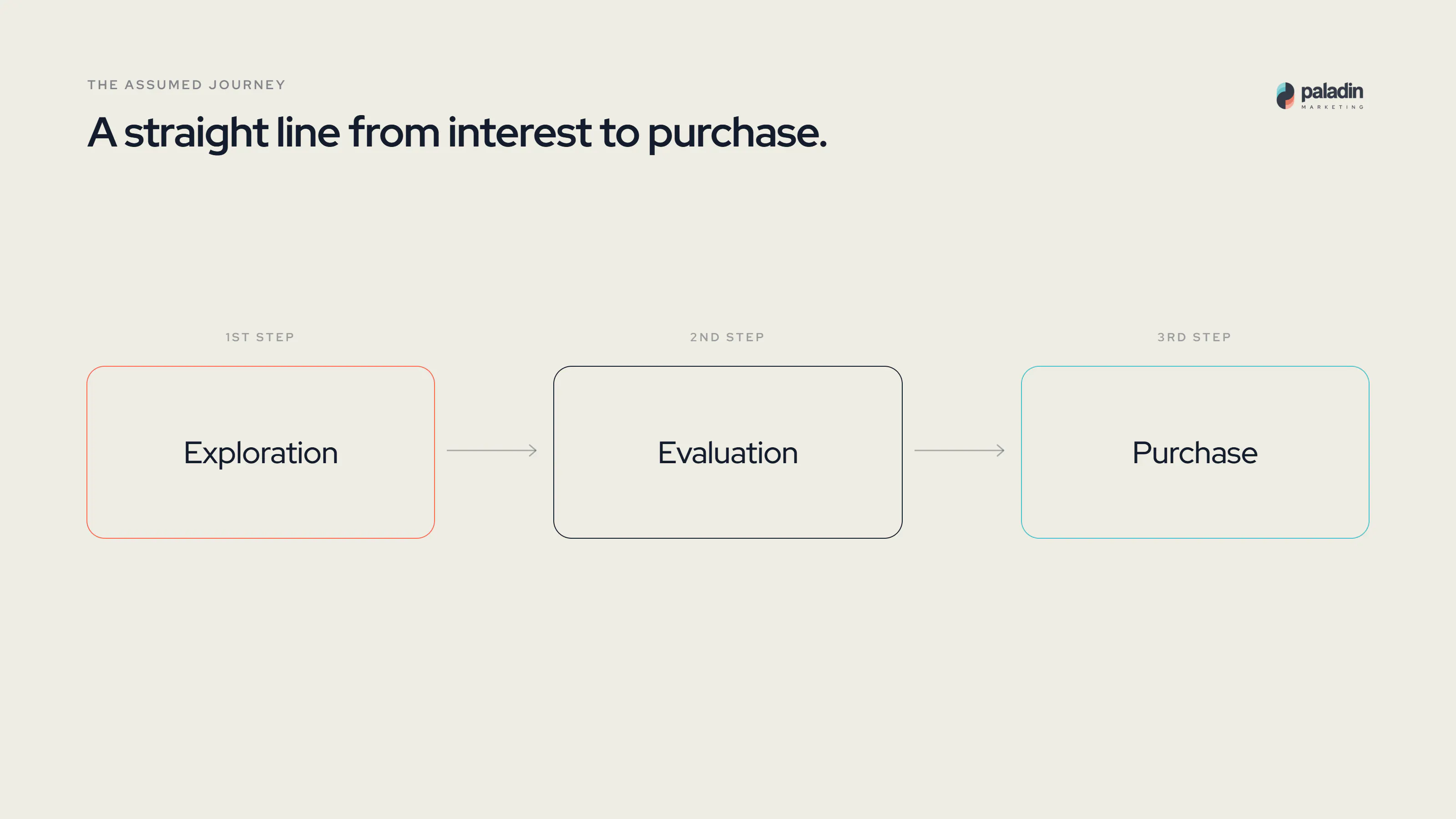
To help us break down a buyer’s journey for marketing purposes, we think of it as a neat and tidy set of linear actions, something like this:
But, what actually happens is the opposite.
Prospects do not move through the ‘buyer’s journey’ in a straight line. They don’t start in the exploration phase, progress nicely through to the evaluation phase, and then land on a purchase.
In reality, there is little to no logic to a prospect’s buying journey such that it looks more like this:
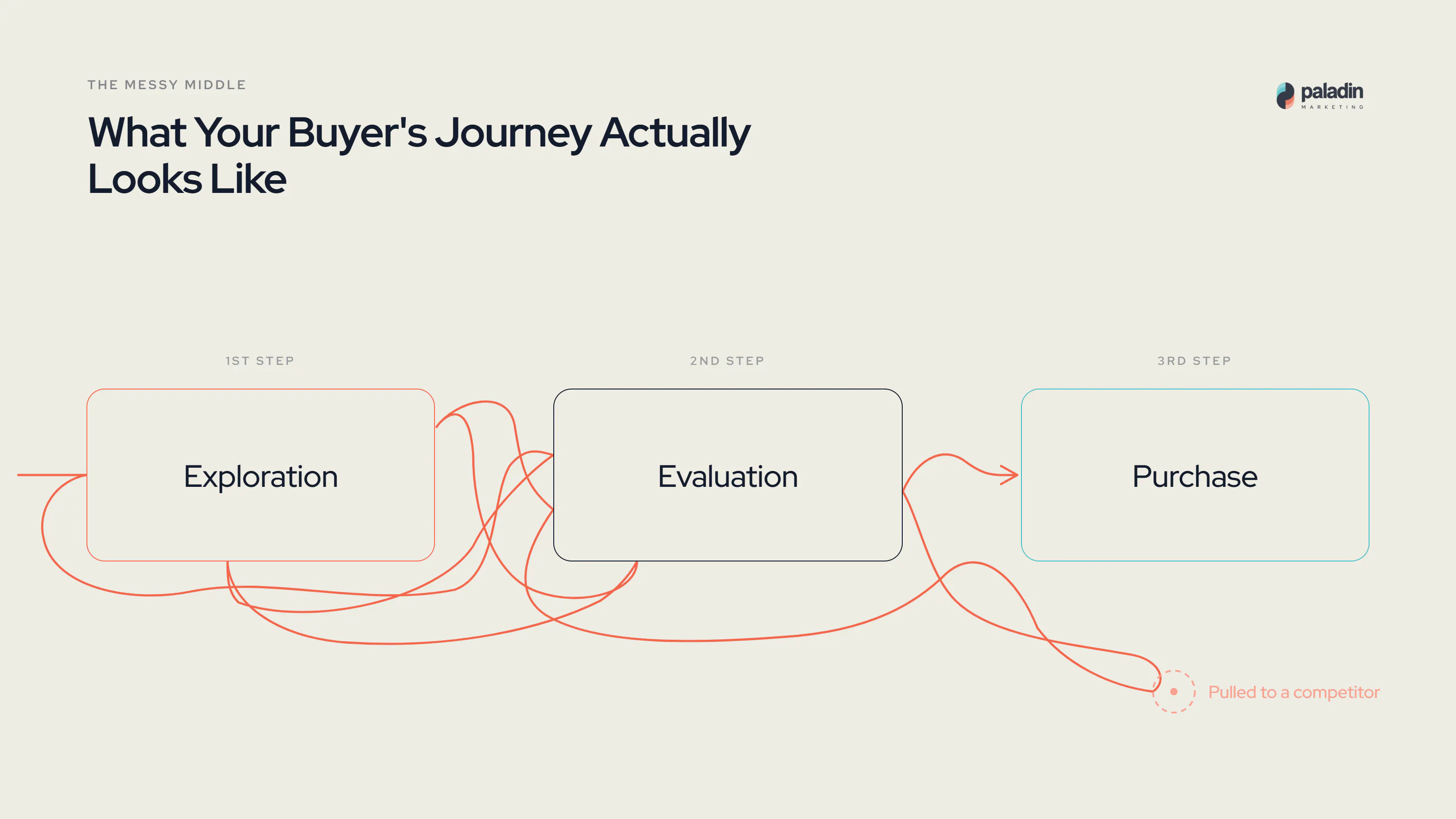
They might stall for weeks, get distracted, come back with a different focus, then disappear, get pulled to competitors, then move suddenly for reasons totally unconnected to the last thing they saw.
It's no wonder the term ‘messy middle’ was coined by Google by their insights team in 2020 when they produced a paper on decoding buyer’s decision making.
The point is buyers jump around all over the place, flipping between mediums and platforms, research and consideration, with no rhyme or reason whatsoever.
At any given moment, the ‘audience’ that your channels broadcast to is actually full of prospects in wildly different emotional and cognitive states.
Yet, they’re all being sent the same marketing messages.
This means the vast majority of your digital marketing is ill-timed and irrelevant when it lands with potential buyers. Consequently, only a tiny fraction catches people at the right moment who are also in the right frame of mind to convert.
This is why no amount of channel-level efficiency tweaks and optimisations will significantly alter your marketing results. Sharper targeting, improved ad bidding, tighter SEO and even better creative will never significantly affect the chaotic reality of the messy middle.
We’ve diagnosed the real problem which explains why you’re sceptical about the vast majority of digital propositions you encounter.
Channel focused digital solutions don’t tackle the real problem because they ignore the realities of the messy middle.
So what can you do about it then?
One word. Resonance.
If the marketing messages you deliver to your target audience resonate more effectively, you’ll get the attention of and convert more of them.
To make your marketing much more resonant you need to navigate the messy middle with increased precision. This starts by flipping your strategy on its head: start with the audience first and map out all of the thoughts and emotions they have in each stage of their buying journey.
Only then, once you know what they’re feeling do you know what to say and how to say it i.e. content and channels.
At Paladin, we call this audience-first marketing.
If you’re anything like me you will have had this unexplained, instinctive sense that your marketing could move the needle. That it could be so successful it would meet and exceed existing commercial targets, and transform your organisation.
Audience-first marketing makes this possible. Take Rangeford Villages for example.
A year or two ago, we applied an audience-first approach to their organic content marketing. In a nutshell, we mapped the specific and distinct feelings of their prospects (retirees) at each stage of their buying journey.
Then, we produced long form articles to provide the information they needed and promoted said information on the appropriate channels.
Here’s what their channel attribution looked like before we did this:
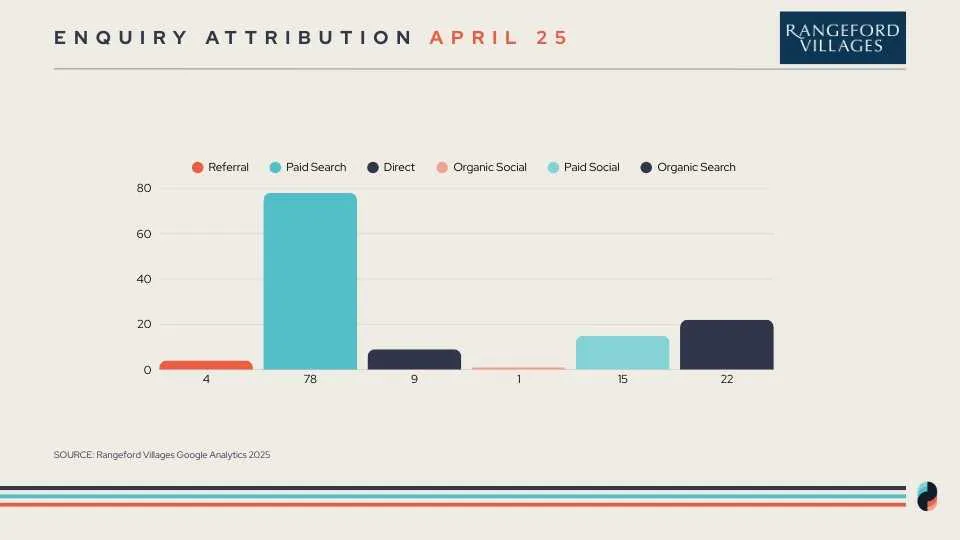
The results were tectonic. Within a few months organic enquiries outperformed paid ads (PPC) by over 40%.
Here’s what it looked like 6 months later:
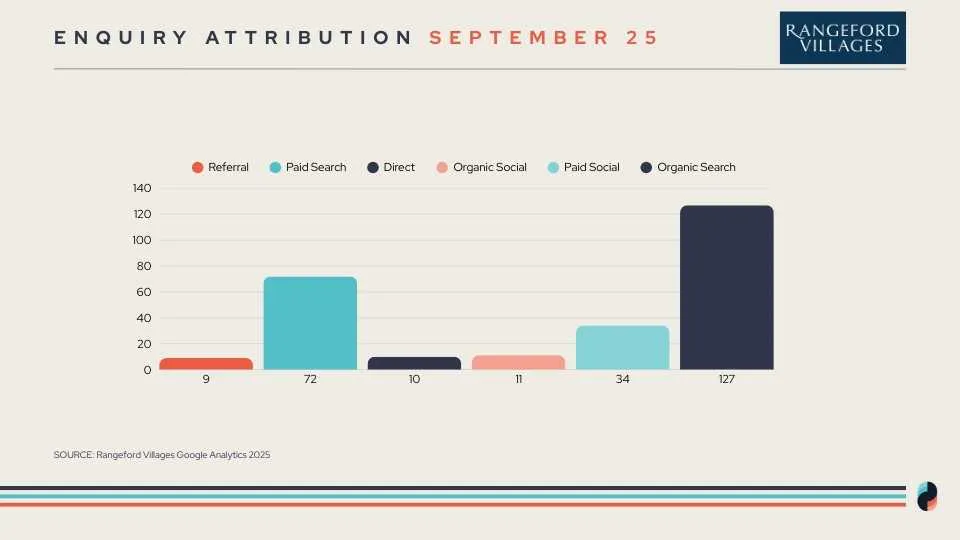
The key point is that: tapping into the buyer’s actual feelings significantly increased the resonance of Rangeford’s marketing which saw enquiries sky rocket as a result.
Going audience-first is a serious undertaking and one that requires a dedicated and comprehensive diagnostic process..
But, you can begin to look at things differently by posing the following questions at your marketing:
1. "When we think of our prospects, do we know what they're feeling or just who they are on paper?"
Demographic insights along with first-party customer data is not the kind of audience mapping we’re talking about here. It describes who someone is, not what's actually stopping them from choosing you.
2. "Was our current marketing plan influenced by the channels we were already using?"
Channel centric digital marketing is inherently limited and ultimately doesn’t tackle the real problem at hand. Until you stop focusing on channels first, your marketing activities will always come up short (versus what is possible).
3. "Does our marketing focus on what prospects need to feel? Or, is it more focused on what we want to say?"
An audience-first approach enables true content marketing that takes single threads of audience feeling and explodes them across all the channels concurrently. Channel focused activities tend to produce fragments that whilst perfectly legitimate and decent enough, simply will not have the same effect on a prospect’s thinking.
Your instincts are spot on.
Channel focused marketing can only get you so far. Not because it’s executed badly but because it’s not the real problem. The only way to drive transformative business growth is through marketing that truly resonates.
Whatever you do next, don’t stop trusting your instincts or ignore what you now know are the inherent limitations of channel focused digital marketing.
Stay Sharp
Straight to your inbox.