Knowledge
How To Attract Self-Funding Families in the Care Home Sector

Knowledge
Human Shaped Thinking
1 October 2026

Gav StevensHead of Performance Marketing
“Mum said she’d fallen again and hadn’t told me for two days.”
This is the point when an adult son or daughter, who lives two hours away from their mother, hits a tipping point and starts searching online for care home options.
Together, they represent the self-funded prospect type which has become the care sector’s biggest marketing challenge as well as its greatest growth opportunity.
Over the past decade, two things have occurred that led us here:
1. The decline in local authority referrals
In 2016, the number of people in council-funded residential care across England was 165,000. Ten years later in 2026, that number is 135,000 as this graph illustrates:
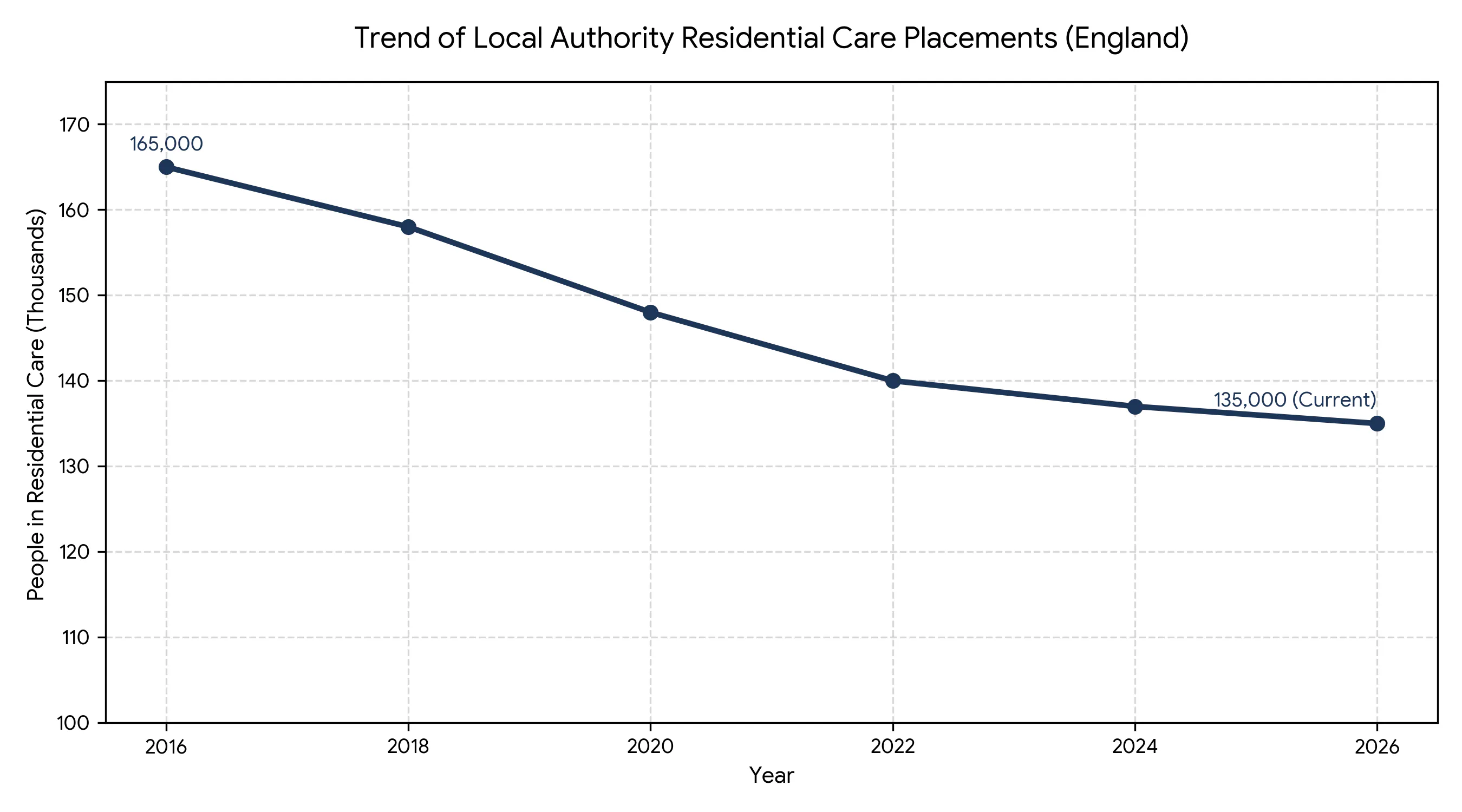
[Data sources: NHS England, 2025; Care Quality Commission, 2025]
The steady supply of new residents that care homes have long relied upon is drying up: fewer prospects are being referred through a social worker's assessment, a hospital discharge team, or a council care package.
As a result, care homes must grow their resident numbers by other means, namely from those able to pay for their own care.
2. Families have had to find their own care home options
Around 40% of UK care home residents are now self-funded, a proportion that is expected to continue growing.
The good news is that self-funders still need extensive information and guidance to make their decision. The absence of an institutional referral route does not change that reality. If anything, it makes finding the right care their own responsibility.
This often begins with an online search, as they try to make sense of what's happening with little idea of what to look for.
A national survey of a thousand people arranging care found that 97% experienced real difficulty. Just over 66% did not even know what type of care they required, and said their final decision was shaped by more than reputation or facilities alone (Log my Care & Care England, 2026).
It goes without saying that there is a significant opportunity to attract self-funders by providing them with the information they need. From a marketing perspective, this means understanding their information needs intimately and tapping into their emotional state.
In other words, you need to provide the right content in the right way – that is, meet them 'on the ground' by understanding:
The remainder of this article addresses each of these in turn: first, laying out the marketing personas, then the key stages of their buying journey and finally, how that understanding translates into content that resonates with them.
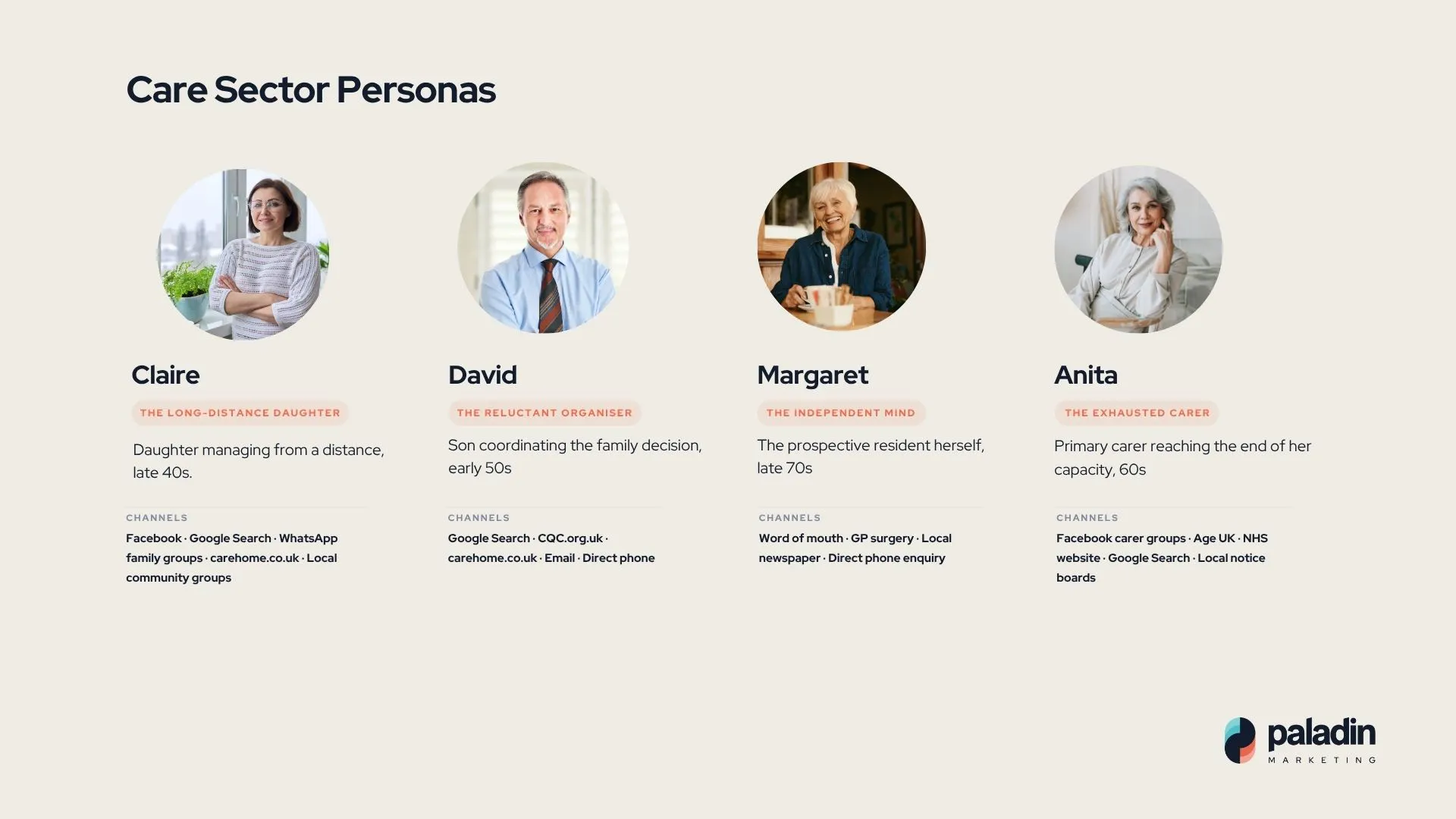
No two families arrive at this search in quite the same way, yet certain patterns recur often enough to be worth naming.
The four personas below are drawn from those patterns, not exhaustive profiles, but useful likenesses for shaping marketing content that speaks to the people actually reading it.
The Long-Distance Daughter
Claire is in her late forties and lives two hours from her mother. She has been holding things together through phone calls and weekend visits for longer than feels sustainable and carries the guilt of that distance every day.
What she is really searching for is somewhere that will let her stop being the emergency coordinator and start being a daughter again.
Channels: Facebook (incl. local community groups), Google Search, WhatsApp family groups, carehome.co.uk
The Reluctant Organiser
David is in his early fifties and pragmatic by instinct. He has become the family's de facto project manager for a situation nobody planned for, whether as Claire's brother or as a sole adult child taking the lead. His focus on research comes from a fear of making the wrong call for people he loves.
Above all, he trusts credentials, evidence, and transparency.
Channels: Google Search, CQC.org.uk, carehome.co.uk, email, direct phone.
The Independent Mind
Margaret is in her late seventies, sharp, and holds strong views about her own life that have not softened with age. She fears the loss of her identity more than the loss of her independence from growing physical limitations.
She is looking for somewhere with real life in it: people worth talking to, a rhythm that feels human, and staff who treat her as someone with a history rather than a need.
Channels: Word of mouth, GP surgery, local newspaper, direct phone enquiry.
The Exhausted Carer
Anita has been caring for her father at home for three years, managing medication, broken nights, and her own family alongside it. She has reached the point of knowing something has to change.
She is looking for somewhere she can trust enough to finally let go. Consistency, visible staff warmth, and the quality of resident reviews are exactly the signals that will bring her to that decision.
Channels: Facebook (incl. carer groups), Age UK, NHS website, Google Search, local notice boards.
There are 4 stages of ‘readiness’ that self-funding prospects travel through. Whilst there are nuances that vary between personas, all four share the same journey, which can be broken down as follows:
To understand what a family is going through, every thought and feeling within each stage needs to be mapped so you know precisely what information will help them cope and move their thinking forward.
The result is what we call a 'Content Core', or simply 'Core' as we've nicknamed it at Paladin, a highly detailed matrix of every thought and feeling that self-funders experience when trying to find a care home.
Once you understand what they feel at each stage of their journey, you can begin producing content that genuinely helps them.
The Core does not stay an abstract matrix for long. Each thought and feeling within it becomes the seed for real, published content.
Below is an example article, with its outline, title, and image suggestion:

This article meets 'Claire' exactly where she is, at the moment after another incident that cannot be ignored. It validates her action, provides proper guidance, and then reassures her that she is doing the right thing.
Here is a second example, at the same stage, but for a different feeling the prospect might be experiencing:
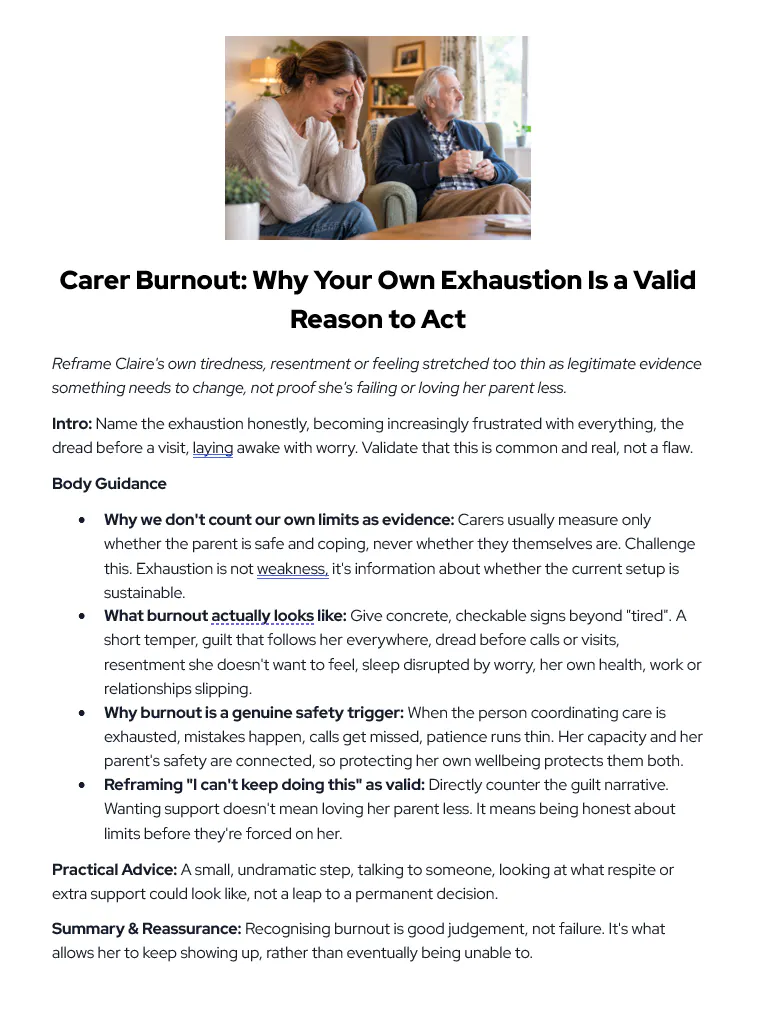
From that single seed topic comes not only the article itself, but all the content needed to promote it: an email, a social post, a remarketing ad, a LinkedIn post, and a Reddit post, each carrying the same message into a different channel.
That's six pieces of content per seed topic. Each thought or feeling within the Core can generate between 6 and 10 seed topics, and each stage of the journey holds 10 to 15 distinct thoughts and feelings.
In other words, there are hundreds of article topics just like these two that self-funders need to help them find your care home.
Everything covered here, the decline in local authority referrals, the rise of families searching largely alone, the personas that describe who they are, the emotional stages that describe where they are, and the Content Core that turns both into material worth publishing, points toward a single conclusion.
The care providers that succeed in future will not be the loudest, or those with the biggest budgets necessarily, but the ones who understand exactly who they're talking to, and why.
Understand your audience at an emotional as well as informational level, and everything else, the content, the channels, and the growth in self-funding resident numbers will follow naturally.
Stay Sharp
Straight to your inbox.